About 40% of greenhouse gas emissions nationwide come from buildings, and that number is closer to 80% in Evanston. Heat pumps are electric appliances that can replace furnaces, traditional air conditioners, and hot water heaters to significantly reduce the carbon footprint of buildings.
How do heat pumps reduce greenhouse gas emissions?
Heat pumps move heat energy from one area to another rather than creating new heat by combustion or electric resistance. So, they are much more energy-efficient than traditional furnaces, air conditioners, and hot water heaters. Efficiency will vary with the outside temperature and building design, but heat pumps can be three times more energy-efficient than gas furnaces.
How do heat pumps work?
HVAC (Heating, Ventilation, and Air Conditioning) heat pumps can run either forward or backward, depending on whether they need to heat or cool an area. Heat pumps can also be either air-source, transferring heat to or from outside air, or ground-source with buried pipes transferring heat below ground. The outside air and the ground contain heat energy even at below-freezing temperatures, and refrigerants flowing through the heat pump system can absorb and transfer that energy due to their low boiling points (that is, the temperatures at which they change from liquid to gas). Newer cold-climate heat pumps can operate at temperatures as low as minus 13 degrees, although efficiency declines at lower temperatures. This diagram illustrates how a heat pump works:
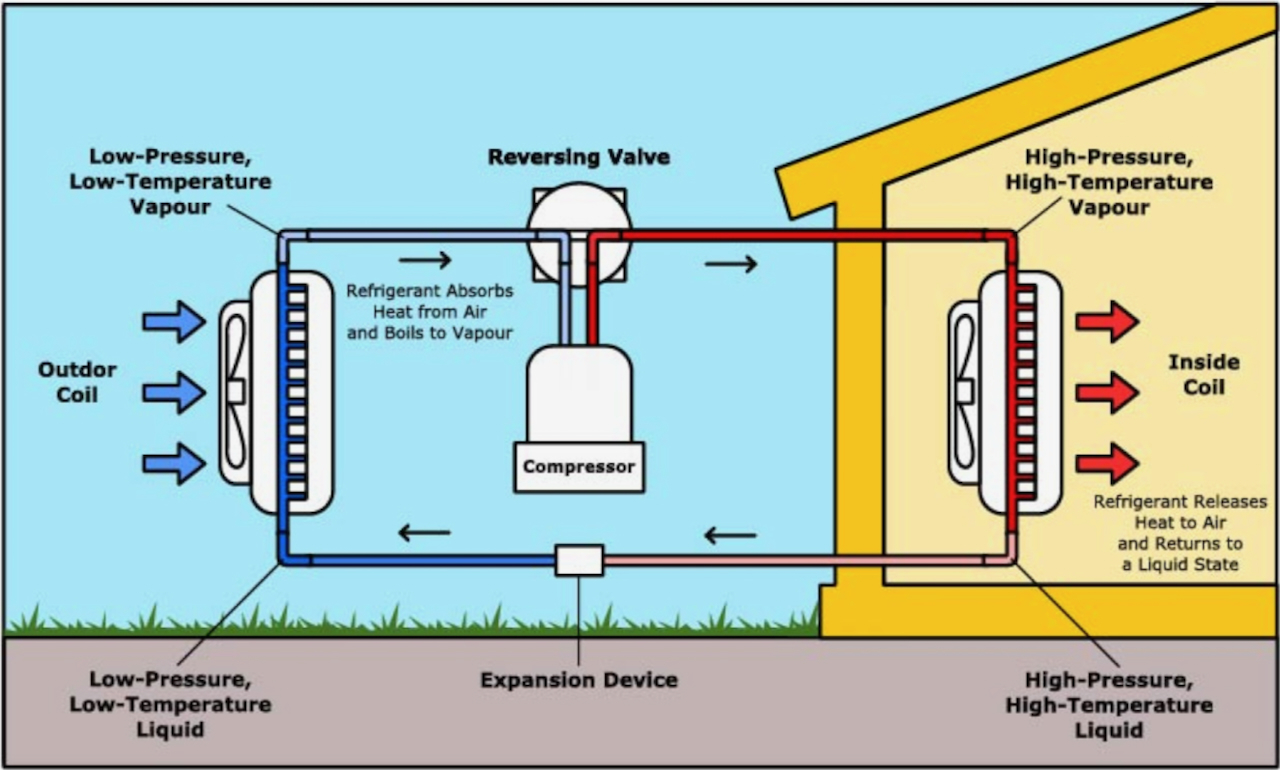
Air Source Heat Pumps Heating Cycle
–Diagram courtesy of the U.S. Department of Energy
In heating mode, cold liquid refrigerant in an outdoor coil absorbs heat energy from the outside and evaporates, becoming a gas trapped within the coil (referred to as “vapour” in the diagram above). The gas is piped to a compressor, which pressurizes it, increasing its temperature. The hot pressurized gas is piped to an indoor coil, where it releases heat into the home’s air or hot water heating system. The refrigerant condenses as its temperature drops and flows to an expansion device, which reduces its pressure and temperature, sending what is now a cold liquid back to the outdoor coil, ready to absorb heat energy and start the cycle over again.
Heat can be circulated through the home via ductwork or, in the case of a single-room wall-mounted heat pump (sometimes called a “mini-split”), transferred to a single room by a fan without ducts. Heat pumps can also be used to heat hot water for floor or baseboard heating.
In cooling mode, a valve reverses the direction of the refrigerant flow, and the heat pump system now operates like an air conditioner, but with better efficiency. The liquid refrigerant in the indoor coil absorbs heat in the home and evaporates. The compressor raises the gas pressure and temperature and sends it outside where it releases the heat. The refrigerant becomes a low-pressure, low-temperature liquid, entering the building ready to absorb inside heat again.
A heat pump hot water heater absorbs heat from inside a room instead of an outside coil to provide heat for showering, dishwashing, etc.
Can I use a heat pump in my home?
Heat pumps are not yet able to produce steam, so currently available heat pumps may not work well to replace steam boilers feeding existing steam radiators. Single-room heat pumps, or mini-splits, may be an option. However, homes with ducted air heating are good heat pump candidates, and homes with hot water radiator or baseboard heaters may be candidates too. Homeowners should learn whether their electrical service has sufficient spare capacity for the system and install any new circuits needed before a failed furnace becomes an emergency. It’s also a good idea to upgrade insulation, fix leaky windows and doors, etc., to make the home as energy efficient as possible.
Almost any home can be a good candidate for a heat pump hot water heater, as long as the electrical circuit is available in advance. Any attempt to reduce the carbon footprint of a home should start with an assessment of the condition of existing equipment, including the electrical circuit. A qualified HVAC contractor can help, and Climate Action Evanston has “Climate Coaches” that offer free planning advice. See the September 2025 Climate Corner for more information on Climate Coaches.