Environmental Justice has been a Local Program focus for the LWVE for two years. Our initial goals included learning about the impact of the Church Street Waste Transfer Station on surrounding neighborhoods and educating our members and others in the Evanston community. We also aimed to recommend advocacy consistent with League positions. Our group was fortunate to connect with the new Evanston Environmental Justice Coalition, composed of several organizations that shared and expanded our interest in the waste transfer station. (See the
February 2025 issue of the Intercom for a report.)
In January the LWVE Environmental Justice group brought together a panel of local environmental justice leaders for a program at the Evanston Public Library called “Beyond the Bin: Environmental Justice Unpacked.” Panel members discussed how the current condition and operation of the Church Street Waste Transfer Station raises real issues of environmental justice. The panel was composed of Dr. Andrew Wymer, co-chair of the NAACP Environmental Justice Committee, and Janet Alexander Davis and Jerri Garl, co-chairs of Environmental Justice Evanston. Mary Gavin, from our League, moderated from a position of deep knowledge of the subject. The event was well attended, with between 40 and 50 attendees.
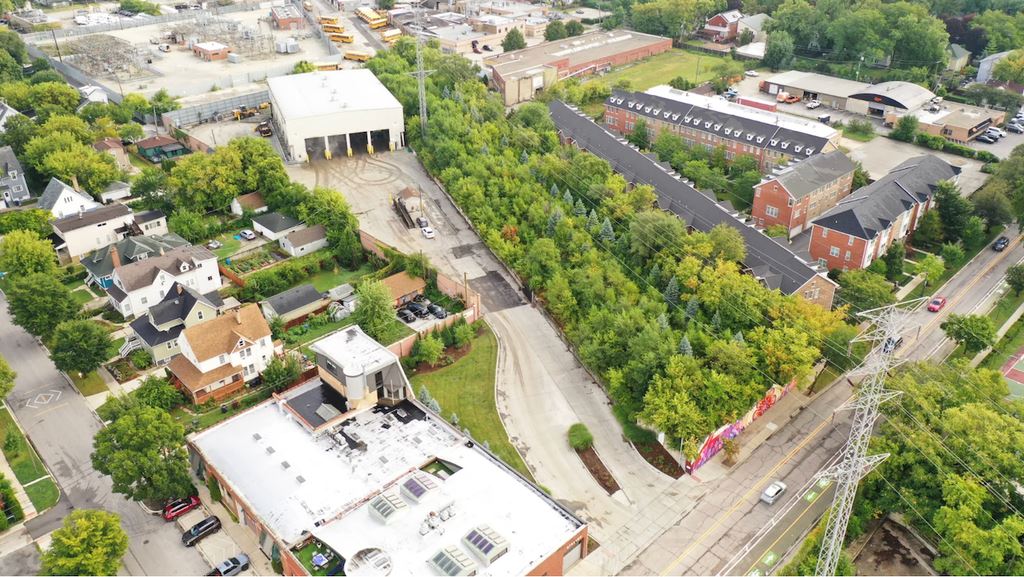 Trucks drive into the solid waste transfer station from Church Street.
Credit: Patrick Hughes Jr.
As explained in a report on the
City of Evanston website, “The Church Street Waste Transfer Station engages in the collection, transfer, and disposal of municipal solid waste and construction and demolition waste. The site is located at 1711 Church Street in Evanston, Illinois 60201 and has been in operation since February 27, 1984.”
Gavin, who has researched and written extensively about the waste transfer station for some time, began the event by recounting some of its history and how the city has responded to the organized protests of its neighbors. She pointed out that even after the State of Illinois mandated that waste transfer stations be located at least 1,000 feet from residential properties, this one in Evanston was grandfathered in and so still stands in close proximity to many Evanston residences.
Janet Alexander Davis, who grew up living not far from the waste transfer station, spoke of peoples’ experiences of living in that neighborhood. The city has made some attempts to require the company now owning the transfer station to reduce harm to its neighbors, but agreements have not been faithfully overseen or adhered to. Jerri Garl spoke in some detail of the environmental pollutants that escape from the transfer station into the air and soil. She described the history of the transfer station as one of institutional racism in Evanston. Andrew Wymer recounted some of the technology behind past and future efforts to measure the pollution caused by the waste transfer station.
Thoughtful questions and answers followed the discussion. Two City Councilmembers attended the event and brought insights about both the waste transfer station and other environmental injustices that remain to be addressed.
Evanston initiated an Environmental Equity Investigation (EEI) in 2024. A report on the investigation was recently completed and was presented to the City Council at its meeting two days after the Beyond the Bin event. (The
full EEI report is on the City of Evanston website.) Several League members attended that meeting and spoke during public comment to urge the city to accept the recommendations in the report and to take them seriously. Several Councilmembers then spoke in favor of making a serious commitment to the recommendations of the EEI, and the City Council voted unanimously to accept the report.