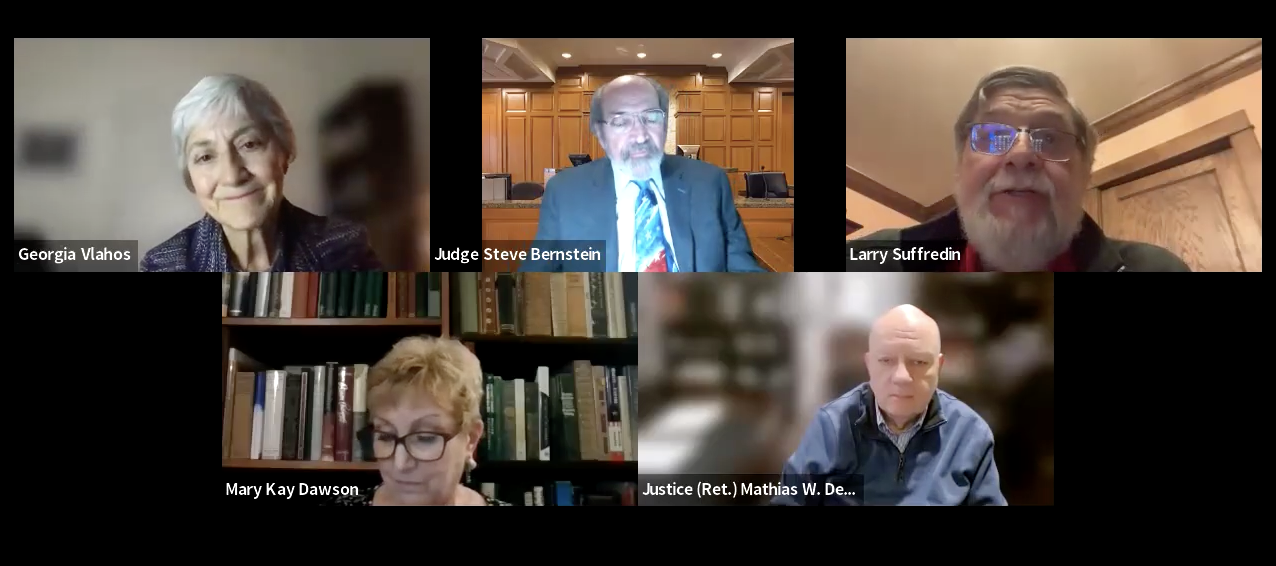
The League of Women Voters of Evanston sponsored an online program for members of our local and area Leagues on February 9. The focus was the election of judges in Illinois . A distinguished panel addressed how one becomes a judicial candidate, ethical standards judges must follow, the importance of voting for judges, resources for voters, and more.
Co-president Georgia Vlahos welcomed attendees and introduced the program moderator, former Cook County Commissioner Larry Suffredin. Panelists included the Honorable Steven Bernstein, Judge of the Circuit Court of Cook County; Mary Kay Dawson, Judicial Political Adviser; and the Honorable Mathias Delort, (Retired) Illinois Appellate Justice.
Commissioner Suffredin provided an overview of the Illinois courts, distinguishing between appellate courts and circuit courts. At the federal level, judges are nominated by the President, confirmed by the Senate, and then serve life terms. In the State of Illinois system, in contrast, judges are elected; appellate court judges serve 10-year terms and circuit court judges serve 6-year terms. Commissioner Suffredin explained the courts’ jurisdictions and introduced the distinguished panel.
For years, Retired Appellate Justice Delort taught candidates the rules about running for judge and the ethics standards they must meet. Limitations on campaigning, for example, include that campaign fundraising must be done by a committee. The candidate cannot ask for funds and cannot even raise funds for any cause such as a local charity or her child’s sports team. It is acceptable to provide biographical information listing organizations to which you belong, even though that might suggest particular points of view, but not acceptable to say how you would vote on an issue. Delort provided a clear picture of the high ethical standards involved but also the challenges they present.
Mary Day Dawson, judicial political adviser, shepherds people through the judicial campaign process, including explaining the requirements to run, i.e., being a licensed lawyer and residing in the judicial jurisdiction. She noted that additional qualifications are reflected in Bar Association ratings through the Illinois State Bar Association (ISBA) or the Alliance of Bar Associations. (Later in the program, however, some limitations of the ratings were addressed.) She advises candidates that they should be able to articulate why they want to be a judge, their qualifications, and how they are contributing to their community in ways that make them seem personable to voters. She concluded her remarks by expressing that running is time-consuming, expensive and stressful– not just for the candidate, but also for the candidate’s family and associates.
Judge Bernstein, of the Circuit Court of Cook County, spoke to his experience as well as that of his wife, the Honorable Jeanne R. Cleveland Bernstein. He spoke of the desire to have judges who know the law and are fair-minded individuals. Bernstein also devoted some time to the inner workings of the court system; for example, all judges start in traffic court. He noted that judges run as representatives of a political party and, through personal anecdotes, illustrated the difficulties of running a partisan campaign for a nonpartisan job. Judge Bernstein also noted that he and his wife share a strong motivation to serve their community and that, despite the challenges, he has found being a judge to be a very satisfying way to do so.
In response to a question about whether panelists think the election of judges might ever be nonpartisan, they responded that this would be difficult to achieve as it would require changing the state constitution and there would be downstate pushback to making this change.
Addressing the difficulty voters have with the long list of retention judges on the ballot, Commissioner Suffredin mentioned a proposed retention amendment intended to introduce merit-based evaluations to replace or supplement the current, often non-competitive retention elections. Asked if there is an adequate number of judges for the Cook County Circuit Court, panelists responded that there is a need for better management of the various divisions of the court, and that it is the criminal division that is most problematic.
It is not possible to capture, in this report, the details and nuances of the court system and the judiciary candidacy experience discussed by these very knowledgeable panelists. We strongly suggest that if you missed the program, you
view the video here or on the LWVE website
event page.